Buying property in the UAE: how five emirates compare for foreign buyers
Dubai, Abu Dhabi, Sharjah, Ras Al Khaimah and Umm Al Quwain compared: transport links, market profile, price level and the freehold areas open to foreign buyers.
Contents
Key points
- Foreign buyers in the United Arab Emirates (UAE) can acquire full ownership in designated freehold areas, but the rules differ from one emirate to the next.
- Dubai is the busiest freehold market with very strong rental demand; Abu Dhabi focuses on planned, family-oriented communities.
- Sharjah is the lower-cost alternative next to Dubai, though in some districts ownership rights depend on the individual project.
- Ras Al Khaimah and Umm Al Quwain are quieter, low-density coastal markets with lower price levels.
As of 5 January 2026, source: overview of the emirates' property markets published on 5 January 2026.
A market built on rules and planning
What sets the UAE apart is a clear legal framework combined with long-range urban planning. For a foreign buyer, the first question is simple: is the property inside a zone where freehold ownership is open to non-nationals? Each emirate draws those zones itself.
Recent development has concentrated on sustainable neighbourhoods, mixed-use schemes and growth that follows new infrastructure. That makes the market relevant both for people who want to live in their home and for buyers looking for long-term value.
Five emirates, five different profiles
The right choice comes down to budget, lifestyle and what you want the property to do for you. Here is how the five most popular emirates compare.
Dubai: the most active freehold market
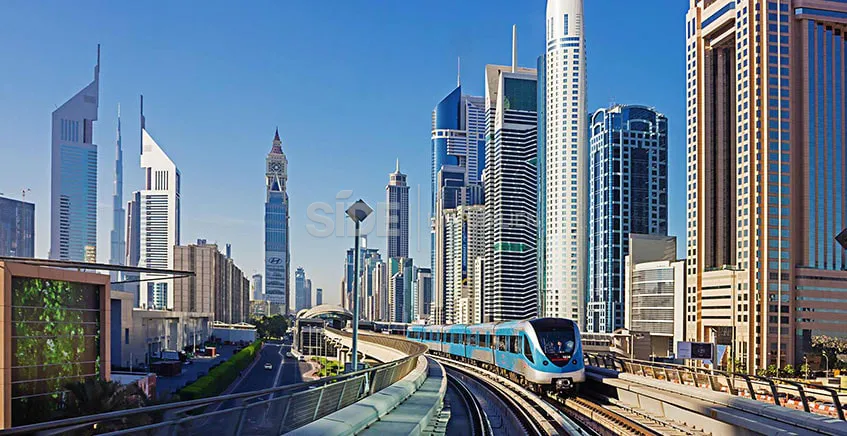
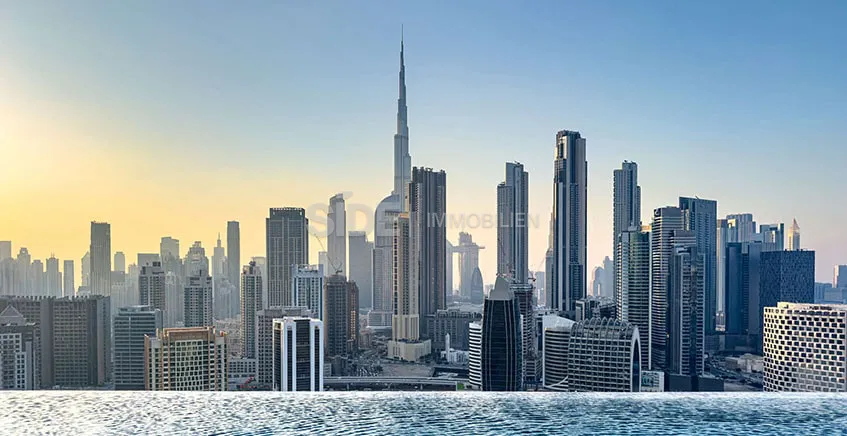
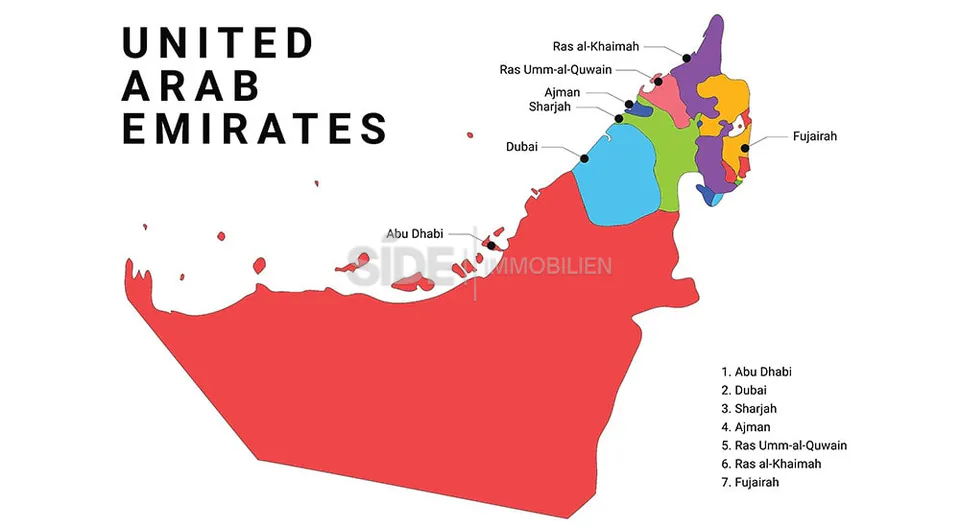
Dubai sits on the north-eastern coast of the Persian Gulf, between Abu Dhabi and Sharjah. Expect high-density city living and well-developed infrastructure.
- Getting around: two airports, Dubai International (DXB) and Al Maktoum International (DWC). The Dubai Metro and the E11 (Sheikh Zayed Road) link the city to Abu Dhabi (about 90 minutes) and Sharjah (about 30 minutes).
- What is on offer: off-plan and ready properties in master-planned communities and mixed-use developments, with a wide price range, strong tenant demand and activity all year round.
- Freehold areas: Dubai Marina, Downtown Dubai, Palm Jumeirah, Business Bay, Jumeirah Village Circle (JVC), Jumeirah Lake Towers (JLT), Dubai Hills Estate, Dubai Creek Harbour, Emaar Beachfront, Dubai Islands, Arabian Ranches, Emirates Hills, The Springs, The Meadows, The Greens, City Walk, Bluewaters Island, Mudon, Town Square, Al Furjan.
Abu Dhabi: the capital's calmer, family-friendly market
The UAE capital lies on the Persian Gulf roughly 140 km south-west of Dubai. Growth here is planned and sustainable, with low- to mid-density housing.
- Getting around: Abu Dhabi International Airport (AUH); the E11 and E10 reach Dubai in about 90 minutes, and the road to Al Ain supports commuting.
- What is on offer: mainly master-planned residential communities and waterfront projects suited to long-term living.
- Freehold areas: Yas Island, Saadiyat Island, Al Reem Island, Al Raha Beach, Al Maryah Island, Lulu Island, Sayh As Sidirah, Al Falah, Fahed Island, Hiid Al Saadiyat, Al Jurf (Ghantoot), Nurai Island, Jubail Island, Al Shamkha, Raha Beach, Al Reef, Palace Breakwater.
Sharjah: value next door to Dubai
Sharjah lies immediately north of Dubai and shares its metropolitan area. It is family-oriented and culturally rich, and prices are generally below Dubai's.
- Getting around: about 25 km from central Dubai, its own Sharjah International Airport (SHJ), and the E11 and E311 to Dubai, Ajman and the Northern Emirates.
- What is on offer: apartments, villas and townhouses in mid- to low-density communities.
- Freehold areas: Aljada, Tilal City, Al Khan, Al Majaz, Muwaileh, Sharjah Waterfront City, Maryam Island, Al Mamsha, Sharjah Sustainable City.
- Check project by project: in areas such as Al Nahda, Al Qasba, University City and Al Khan, ownership rights can vary depending on the development.
Ras Al Khaimah: coastline and space in the far north
Ras Al Khaimah (RAK) is the northernmost emirate, about 100 km from Dubai. Tourism-linked property and residential projects set in natural surroundings are driving its growth.
- Getting around: the E311 (Emirates Road) and E611 (Sheikh Mohammed Bin Zayed Road) connect it to Dubai (about 90 minutes), Sharjah and the Northern Emirates; it also has its own regional airport, Ras Al Khaimah International (RKT).
- What is on offer: residential communities, waterfront and mixed-use projects for long-term occupancy, with apartments, villas and townhouses in low- to mid-density layouts.
- Freehold areas: Al Marjan Island, Al Hamra Village, Mina Al Arab, RAK Central, Dafan Al Nakheel.
Umm Al Quwain: small-town coastal living
Umm Al Quwain lies on the UAE's northern coast and offers a relaxed seaside pace with some of the most affordable prices in the country.
- Getting around: about 50 km to Dubai and 30 km to Sharjah; international travel goes through Sharjah (SHJ) or Dubai (DXB).
- What is on offer: mostly small-scale, low-density developments with apartments, villas and townhouses for long-term use.
- Areas open to foreign buyers: Al Salamah (Al Serra / Al Salam City), Umm Al Quwain Marina, Downtown UAQ, Sobha Siniya Island, Al Rass, Siniya Island, Al Naseem City, Blue Horizon City, Palm UAQ.
Side-by-side comparison
General price level
- Dubai: high, with a wide range
- Abu Dhabi: mid to high
- Sharjah: mid to low
- Ras Al Khaimah: mid
- Umm Al Quwain: low
Lifestyle
- Dubai: urban and fast-paced
- Abu Dhabi: family-oriented and planned
- Sharjah: community-focused
- Ras Al Khaimah: coastal and relaxed
- Umm Al Quwain: quiet and small-scale
Rental demand
- Dubai: very strong
- Abu Dhabi: moderate
- Sharjah: selective
- Ras Al Khaimah: growing
- Umm Al Quwain: limited
Transport and airports
- Dubai: metro plus two international airports
- Abu Dhabi and Sharjah: international airport and highways
- Ras Al Khaimah: regional airport and highways
- Umm Al Quwain: access via nearby major airports
Freehold availability
- Dubai: very widespread
- Abu Dhabi: designated zones
- Sharjah: project-based
- Ras Al Khaimah: designated areas
- Umm Al Quwain: designated area
Three questions before you shortlist
- Is the address freehold? Not every location is open to foreigners, and in Sharjah the answer can depend on the project.
- Rent or live? According to the source, rental demand is strongest in Dubai; buyers after peace and quiet tend to look at Ras Al Khaimah or Umm Al Quwain.
- How far is daily life? Travel times between the emirates, such as roughly 90 minutes from Dubai to Abu Dhabi or Ras Al Khaimah, shape everyday routines.
Area lists and rules reflect the source at the time of publication and may have changed since, so please check the current position. This article is general information, not legal or tax advice.
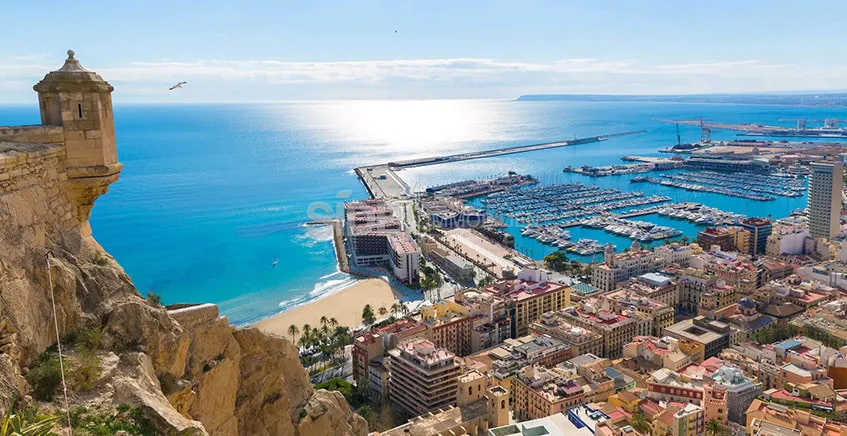
Comparing with the Turkish Riviera
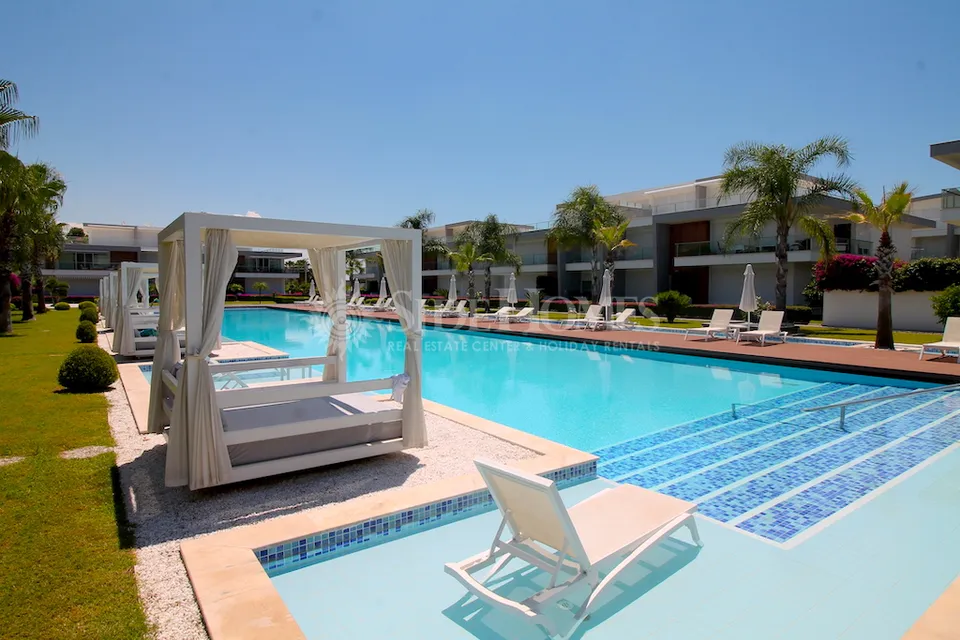
If Turkey is also on your list, the Mediterranean coast is worth comparing. You can browse current listings on the Turkish Riviera under properties for sale, get a feel for the area on our Side page, or simply contact us with your questions.